
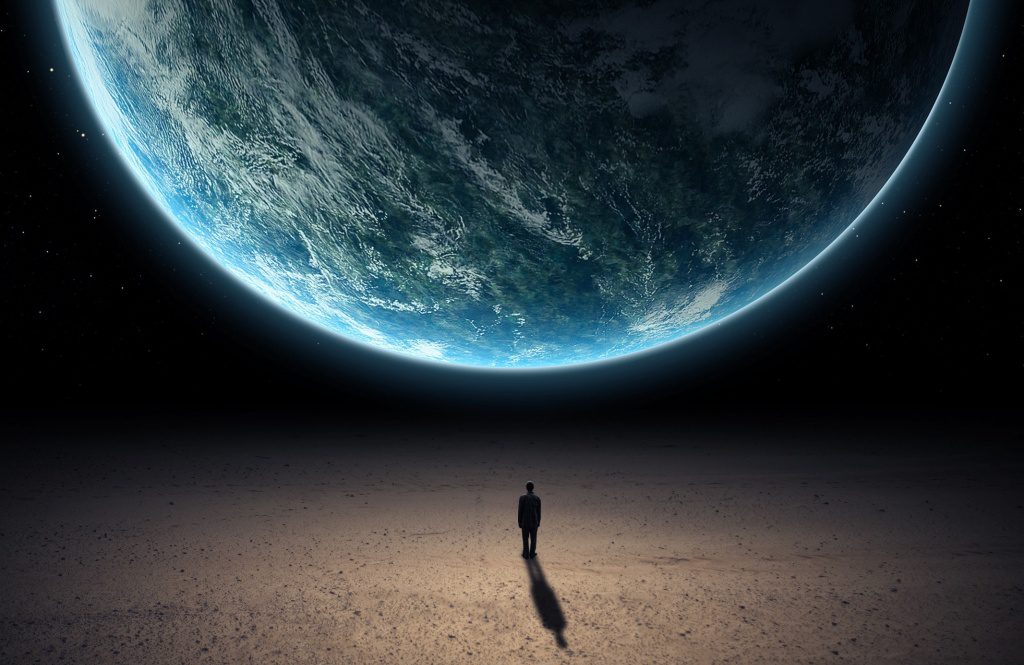

“We are but dream characters in the mind of God, striving for Self-realization, though only a select few may consciously remember this. Most identify entirely with their egos, and this generates great inner conflict.”
– Leon, from The Monarchs
Awards and recognitions keep rolling in for my debut novel, The Monarchs, for which I am very honored and grateful.
Following a rave review in which they called the book “a mesmerizing tale set in a chaotic yet magical and spiritual futuristic dystopia” (I love this line), Literary Titan bestowed The Monarchs a gold medal in their monthly book awards program.
According to their website, the Literary Titan Gold “honors books that exhibit exceptional storytelling and creativity. This award celebrates novelists who craft compelling narratives, create memorable characters, and weave stories that captivate readers. The recipients are writers who excel in their ability to blend imagination with literary skill, creating worlds that enchant and narratives that linger long after the final page is turned.” All books that receive five-star ratings are automatically entered into the Gold Award category and are then further reviewed by a panel of judges.
This is the third award that The Monarchs has won since its release in June. Last month, the book was announced as a winner in American Book Fest’s 2024 American Fiction Awards in the category of New Age Fiction and Finalist in two other categories. Subsequently, the book won a Firebird Book Award in the categories of Science Fiction and Dystopian. I recently spoke with Pat Rullo, who organizes the charitable Firebird Awards, on her radio show to discuss the novel and its inspiration. We had an amazing conversation that you can listen to at this link. (For those who are interested in reading more about the deeper topics and themes behind The Monarchs, please also check out the print interview I did with Literary Titan, which I will post at the end of this article.)
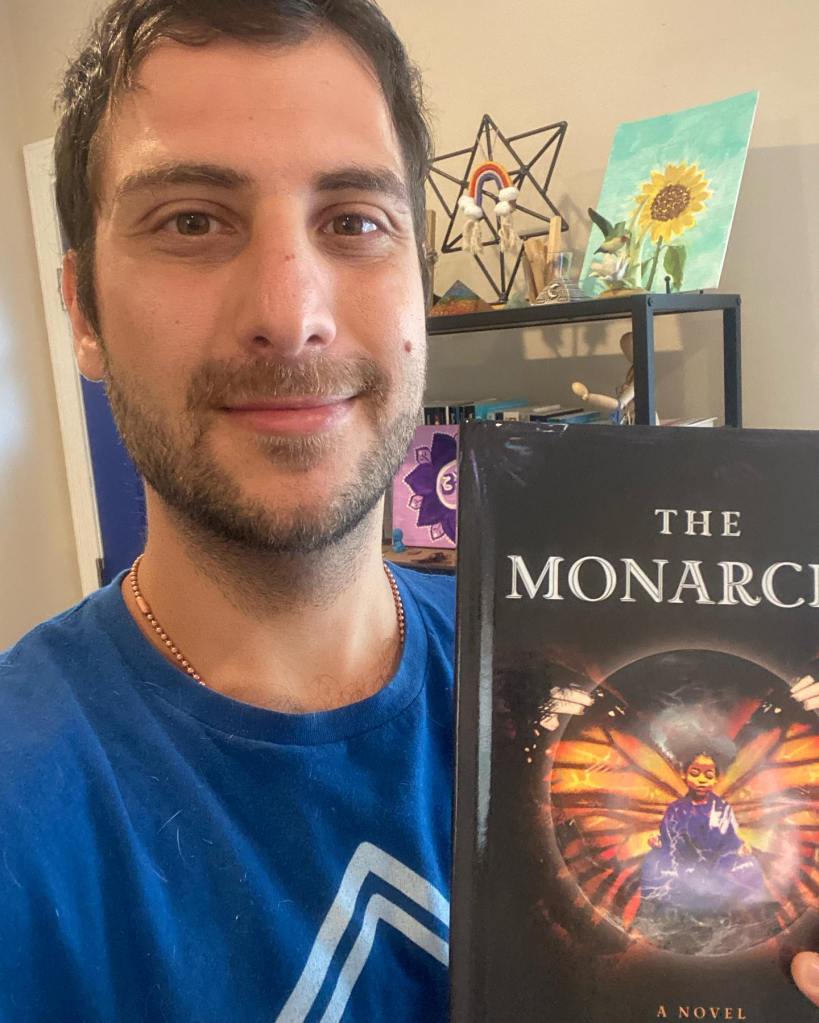
I can’t deny the satisfaction that comes from winning a book award as an author. There is a sense of recognition for all of the time and loving energy that we spent crafting our stories; our books become our babies that we thrust out into the world, and it brings us joy to see them doing well for themselves! Plus, as my wife reminded me, I can now call myself an “award-winning author.” But does this mean that I’ve finally “made it?” Is this what it means to be truly happy?
While winning a book award (or attaining any other accolade) certainly yields temporary gratification, one may soon realize that not long after the initial high, it does not bring true, lasting happiness. The universe inevitably confronts us with unforeseen challenges, and one might even think that life has suddenly gone terribly wrong. This world of form with all of its pleasures is but a transient dream, and those things we were once attached to (be it money, status, physical appearance, worldly recognitions or material treasures) eventually fade away.
The key, according to Buddhist philosophy, is non-attachment—not only to material things but also to our egoic identity, which ultimately is also a temporary dream. And yet the ego craves external validation. It seeks to separate from others by whatever means it has at its disposal, whether by a superiority complex or a victim mentality. When things go right, it clings to its accomplishments, taking them on as part of its identity. And when things go wrong, it points fingers at others, blaming the world for how terrible life has become because in the ego’s eyes, it can do no wrong.
I’m not totally discarding the ego here. We need an ego to be in this world; it is what protects us and gets us through life. However, the ego is also incredibly stupid, even though it thinks it knows everything. If we allow the ego to be in the driver’s seat in our lives, and mistakenly believe that it is our ultimate identity, we will never be truly satisfied. Chasing after worldly riches, recognition and fame is a never-ending game; rather than supporting and uplifting one another, the ego turns life into a competition. It will lead us along an endless, winding road of needing to do more and more until it drives us off a cliff.
I am reminded of what a wise character, Johanna, says in The Monarchs: “more important than doing, we are first cultivating a state of being. True change starts by going within and making peace with yourself. All else is simply a reflection.” In other words, true, lasting peace and contentedness do not come by way of doing or accomplishing anything, but by shifting our own state of consciousness. Anything else that stems from that internal shift (be it book awards or material abundance) are external reflections that—although they might be nice “add-ons”—are not the source of the contentedness.
I once listened to spiritual teacher and best-selling author Eckhart Tolle say that if he were to time travel to the past and tell his former self that he would sell millions of books and achieve fame and fortune, but derive absolutely no true satisfaction from it, his former self would think that he was crazy. Although I am not even close to obtaining the level of worldly “success” that Eckhart has, I can see why this is true. The tools of the ego with its thought-based constructs can never arrive at inner peace and bliss. On the contrary, peace is the byproduct of transcending the egoic personality—with all of its self-made problems and personal history—and allowing oneself to be guided by a higher intelligence. Everything in form is temporary, but contentedness comes by way of being in touch with one’s eternal formless essence.
To anyone reading this, whether or not you recognize it on a conscious level, you are a child of God (a fractal of source consciousness, if you prefer more scientific terminology). Absolutely nothing can change that. There is no “making it” in life (whatever that means) because deep inside of your soul you are already there. The very fact that you exist means that you are an integral part of creation. So rest in the wisdom of the heart rather than the labyrinth of the mind, and let your inner light shine. There is no need for any more validation. Shed away the past and be reborn in this moment.
This process of dying to the old, egoic self is what some traditions call “enlightenment” or the end to suffering (in Christian theology, this is also what Jesus was likely alluding to when he spoke of being born again). The ironic part is that only once this commences does the worldly stuff come rolling in. But even though The Monarchs is doing well, and it is a role I am happily playing to write and now market the book, I be careful not to haul around a fictitious, conceptual identity surrounding it, nor do I really even think of the novel as my own.
The Monarchs is all about transcending the egoic delusion of the separate self, and the less our sense of peace and happiness derives from saying “I am an award-winning author” (or any other mind-made character) and the more it stems from the eternal “I am” presence, that is the extent to which we have spiritually grown.
So, the novel has developed a life of its own, apart from my identity. Still, I am proud for my baby.
I expand on these themes in the Literary Titan interview which you may read below:
Literary Titan Author Interview – Mark Sabbas

The Monarchs follows a teenage boy with unique psychic abilities living in a laboratory who escapes and goes on the run with an ordinary orphan girl. What was the inspiration for the setup of your story?
This is a good question, as it is often difficult to discern the source of the inspiration. The original idea for The Monarchs came to me all the way back in 2014 during a senior year of college spring break beach trip. At the time I was questioning what I wanted to do with my life (having chosen philosophy as one of my majors) and was searching inward for answers. My own process of spiritual awakening, questioning the nature of reality, and exploring the potentials of consciousness through modalities such as lucid dreaming were obvious inspirations for this novel and are reflected in Samuel’s journey.
Moreover, I’ve always been fascinated with psi phenomena and the possibility of supernormal abilities. Even as a kid, I was obsessed with the movie Matilda—about a young girl who could move objects with her mind—and the X-Men series. Eventually, I came across the concept of indigo children which reignited my interest in supernatural abilities—as well as a possible shift in human evolution—and inspired the idea for “new youth” children. Music was another big inspiration, particularly M83’s “Midnight City” music video, which shows psychic kids being tested at a facility. Only later when I researched the Montauk Project, which the show Stranger Things is based on, did I understand that this might be more of a reality than most people realize.
One point I’d like to add is that although the novel may be taken literally (a teenage boy with psychic powers escaping a facility), from another perspective, it may be interpreted as an allegory for spiritual awakening and enlightenment. The opening scene, which is very dreamlike in nature, shows Samuel attempting to escape the laboratory complex with no end in sight. This represents the endless maze of the thinking mind, the dream of the egoic personality which many teachers and mystics insist that we must awaken from. Luna hints to this later in the novel when teaching Samuel how to meditate: “Beyond the thinking mind, escaping its never-ending labyrinth of illusion, there exists a force infinitely more intelligent.”
From there ensues a hero’s journey which forces Samuel out of his comfort zone, leading him to confront his shadow, learn through challenges, and awaken to his essential oneness with God (or, using an analogy of a book, oneness with the author and all other characters). This culminates with him breaking out of character and transcending the strings of time—symbolizing cutting the cords to his past and dying to his time-based egoic self. The evolution and awakening of Evelyn from her coma also represent that of the earth and humanity as a whole. This novel is loaded with symbolism and synchronicity, and although I left several things up to interpretation, there are many Easter eggs and hidden surprises that readers may not immediately pick up on.
The writing in your story is very artful and creative. Was it a conscious effort to create a story in this fashion or is this style of writing reflective of your writing style in general?
Thank you for the kind words. Because music is a central theme (and I often used lyrics from popular songs in the dialogue), in general I did try to make the writing more lyrical and poetic, allowing the sentences to flow in a smooth manner. I wanted my writing to be affecting to the reader, instilled at points with uplifting wisdom, while being careful not to sound verbose or pretentious. Truthfully, because this is my first novel, it took me a while to find my writing style, and it is still a learning process. It took a leap of faith, and years of trial and error, to trust the ideas that came to me and discover how to put them together into a coherently written story. My editors were also a big help. I am grateful for the journey.
What were some themes that were important for you to explore in this book?
Beginning with Samuel’s conversations with his wise tutor, Walter, and expounded on thereafter, this novel explores several philosophical and metaphysical themes, including the existence of God, free will versus predeterminism, human evolution, planetary ascension, and the dreamlike nature of reality. Before embarking on his hero’s journey, Samuel tells Walter that he feels he has no control over his own destiny—that he is trapped like a puppet on a prewritten path. Here and at points throughout the book, we see Samuel developing a sort of metacognition of being a character in a novel—one who indeed is on a path that is already written, yet strives for free will.
Samuel must reconcile this paradox with the ultimate realization of his essential oneness with God (again, oneness with myself as the author). There is no separation between me, him, and all other characters; it is simply an illusion, a game of “one consciousness interacting with itself.” From this highest level, beyond the conditioned limitations of the egoic personality and into God or “author” consciousness, Samuel comprehends that he does have free will, as in a sense he has “written all of it.” His identity as the small, helpless, separate character dissipates as he attunes to the power to write his own destiny. He dies to his old self and is reborn as a Monarch, a symbol of personal sovereignty and spiritual transformation.
As previously mentioned, music is a central theme, as is the idea that we are living in a musical universe, or the view that “all things could be expressed through vibration, sound, and geometry.” To compliment this theme, many song lyrics are quoted in the book, some explicitly referenced, and others hidden in the dialogue. Samuel gradually picks up on the fact that there is music all around him—that his consciousness is but one note in a cosmic symphony. I had to receive print license permissions for 24 different songs to be included in the novel, from artists ranging from The Beatles to Fleetwood Mac to Jimi Hendrix to The Flaming Lips. This was a journey in itself, but it was worth it to preserve the musical element. Some song references may contain hidden clues pertaining to the story when interpreted correctly.
The book is not without darker themes, including the perpetual cycles of human war and division, government corruption and secret experimentation (some researchers have spoken of “Monarch” mind control programming, which is the lesser-known negative connotation to the symbol). Although another human division is introduced in the book, between the larger-eyed “new youth” and the “ordinary” people and children, the ultimate theme I strove to emphasize is that only through unconditional love, acceptance, empathy, and forgiveness can we truly heal our planet and transcend the influences that have long kept us divided.
As the sagacious Leon puts it, “We are but dream characters in the mind of God, striving for Self-realization, though only a select few may consciously remember this. Most identify entirely with their egos, and this generates great inner conflict.” We all have a choice to stay stuck in our characters, our narrow ego identities trapped in the game of duality and separation, or strive toward something higher—a deeper connection with ourselves, with nature, and with all other beings. Taking this path requires a leap of faith into the unknown, opening our hearts and allowing a greater intelligence to guide us through life, which is one of Samuel’s main lessons.
I find a problem in well-written stories in that I always want there to be another book to keep the story going. Is there a second book planned?
Another great question. During most of my time writing The Monarchs, I didn’t plan for there to be a second book. Yet as my first editor told me, this story is almost too big to contain in just one book. I now realize that it is meant to be a trilogy, and I have already (albeit very loosely) outlined the story for books 2 and 3. I’m not going to give it away, but it will be done in a way that plays with time, lending a chance to fill in more of Samuel’s backstory, his time at the Facility, and the world in general, while also pointing toward an incredible future destiny.
Books 2 and 3 will further explore mind-bending themes such as the multidimensional nature of self, extraterrestrial life, other incarnational existences, and even other timelines. I’m excited to expand on this story, and I will continue to trust what comes to me. Stay tuned and thank you for the support.
 Nothing to Doubt Blog