The Monarchs Wins Literary Titan Gold, American Fiction Award, and Firebird Award (Plus Metaphysical Musings On What It Means To Be Happy)

“We are but dream characters in the mind of God, striving for Self-realization, though only a select few may consciously remember this. Most identify entirely with their egos, and this generates great inner conflict.”

– Leon, from The Monarchs

Awards and recognitions keep rolling in for my debut novel, The Monarchs, for which I am very honored and grateful.

Following a rave review in which they called the book “a mesmerizing tale set in a chaotic yet magical and spiritual futuristic dystopia” (I love this line), Literary Titan bestowed The Monarchs a gold medal in their monthly book awards program.

According to their website, the Literary Titan Gold “honors books that exhibit exceptional storytelling and creativity. This award celebrates novelists who craft compelling narratives, create memorable characters, and weave stories that captivate readers. The recipients are writers who excel in their ability to blend imagination with literary skill, creating worlds that enchant and narratives that linger long after the final page is turned.” All books that receive five-star ratings are automatically entered into the Gold Award category and are then further reviewed by a panel of judges.

This is the third award that The Monarchs has won since its release in June. Last month, the book was announced as a winner in American Book Fest’s 2024 American Fiction Awards in the category of New Age Fiction and Finalist in two other categories. Subsequently, the book won a Firebird Book Award in the categories of Science Fiction and Dystopian. I recently spoke with Pat Rullo, who organizes the charitable Firebird Awards, on her radio show to discuss the novel and its inspiration. We had an amazing conversation that you can listen to at this link. (For those who are interested in reading more about the deeper topics and themes behind The Monarchs, please also check out the print interview I did with Literary Titan, which I will post at the end of this article.)
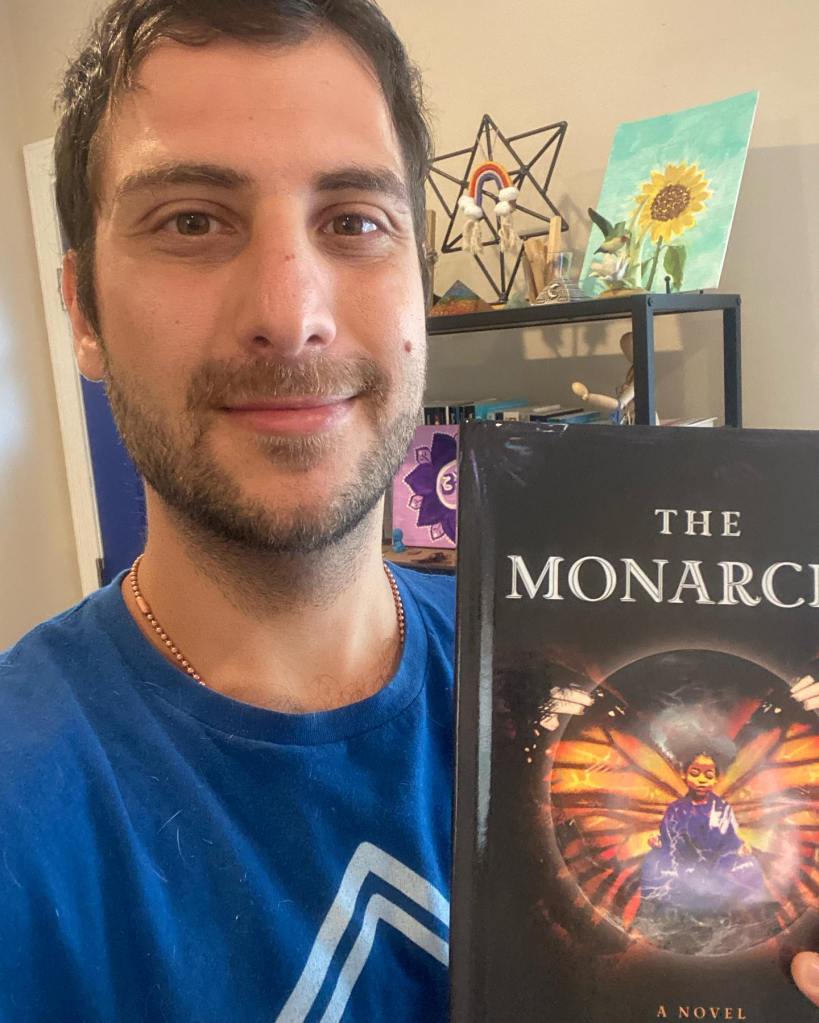
me and my baby

I can’t deny the satisfaction that comes from winning a book award as an author. There is a sense of recognition for all of the time and loving energy that we spent crafting our stories; our books become our babies that we thrust out into the world, and it brings us joy to see them doing well for themselves! Plus, as my wife reminded me, I can now call myself an “award-winning author.” But does this mean that I’ve finally “made it?” Is this what it means to be truly happy?

While winning a book award (or attaining any other accolade) certainly yields temporary gratification, one may soon realize that not long after the initial high, it does not bring true, lasting happiness. The universe inevitably confronts us with unforeseen challenges, and one might even think that life has suddenly gone terribly wrong. This world of form with all of its pleasures is but a transient dream, and those things we were once attached to (be it money, status, physical appearance, worldly recognitions or material treasures) eventually fade away.

The key, according to Buddhist philosophy, is non-attachment—not only to material things but also to our egoic identity, which ultimately is also a temporary dream. And yet the ego craves external validation. It seeks to separate from others by whatever means it has at its disposal, whether by a superiority complex or a victim mentality. When things go right, it clings to its accomplishments, taking them on as part of its identity. And when things go wrong, it points fingers at others, blaming the world for how terrible life has become because in the ego’s eyes, it can do no wrong.

Read more
Group of Teenagers are Invited Onboard Arcturian Extraterrestrial Spacecraft, Remote Viewing, and New Podcast Announcement

In the inaugural episode of The Mystery Temple Podcast, Adrian Solomon and I interviewed our good friend Beth about extraterrestrials, remote viewing, astral travel, planetary awakening, and other mind-bending metaphysical topics.

Beth is a wonderful, genuine soul whom I’ve gotten to know from being in the same weekly meditation and remote viewing group (more on that in a bit). I also had the chance to hang out with her in person for a few days at the 2023 Journey to Truth conference. What you probably won’t guess from initially meeting her is that she has experienced one of the most extraordinary cases of benevolent ET contact that has ever been reported, and also one of the most credible, due to the level of corroboration. Let’s dive in.

Group Contact Experience with Arcturian Beings

During the summer of 1989, a 20-year-old Beth was lying in bed one night when she saw a bright light shining through her window. She ran down the hall and, eerily, the light stayed fixed on her through the wall. “We need you to come with us,” said a voice in her head, “but we won’t take you until you say okay.”

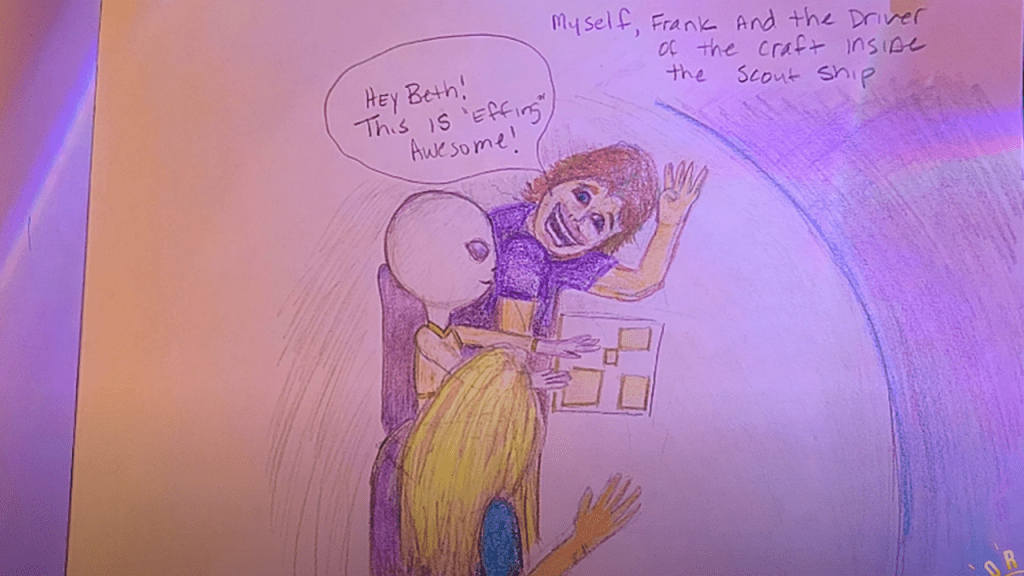
After consenting, Beth was transported onboard a scout ship with a small, grey-looking being who was driving the craft as well as her friend Frank, who waved at her and yelled, “this is fucking awesome!”

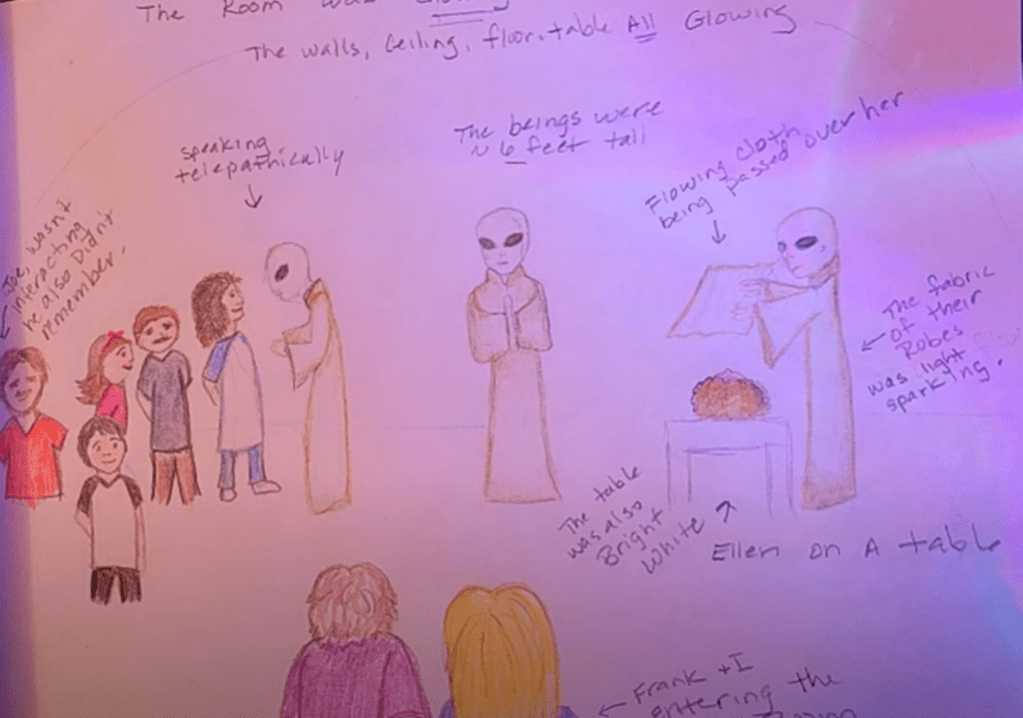
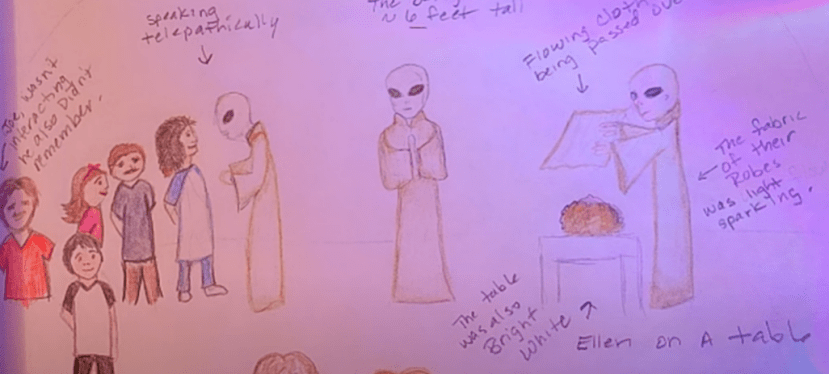
One of Beth’s hand-drawn pictures of the event

Beth and Frank soon boarded a larger craft where they saw six other people they knew—including friends and people they worked with—as well as several tall, graceful-looking beings with large, loving eyes and flowing robes; these otherworldly beings exuded an aura of peace and communicated with the group telepathically.

One of their friends, Ellen (whose mother was also present), was lying on a table while a being was running a silver cloth around her, which seemed to be interacting with her energy field. When Beth’s turn came, she received the same treatment, and she got the impression that the beings were measuring their energy and frequency level, in addition to giving them healing.

Subsequently, another being telepathically invited Beth to look at a different portion of the ship where she saw a gorgeous waterfall and bountiful garden replete with bioluminescent plants.

The being proceeded to tell Beth that they are teachers and guardians who have been here “from the beginning” and that they “collect beautiful things” and bring them to other planets. They told her that she has been given information that she will remember when the time is right (this might partly refer to a math equation that Beth reveals on our show) and that they will be gifting the bioluminescent plants to humanity.

When asked of their origin, the beings told Beth and Frank “you would call us Arcturian.” This corroborates with several other reports from contactees which describe these Arcturian beings as extremely advanced, ancient, benevolent galactic guardians.

Read more

My Debut Novel, Creativity, and The Question of Identity

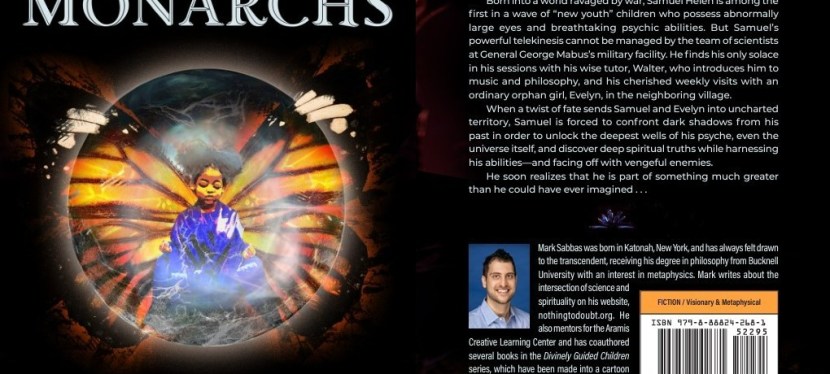
After several years of writing, editing, and diving headfirst into the world of publishing, my debut novel, The Monarchs, is set to be released on June 25th of this year, currently available for preorder from major retailers (links on homepage). Published by Koehler Books, a small Virginia-based publisher which has a close-knit team I’ve much enjoyed working with, this novel is a culmination of a ten year journey ever since I received the original idea for it back in 2014, and is truly a reflection of my own spiritual awakening.

The Monarchs tells the story of seventeen-year-old Samuel Helen, one of the first in a wave of “new youth” children born into a war-ravaged world with abnormally large eyes and breathtaking psychic abilities. When the book begins, Samuel has already spent ten years at General George Mabus’s military facility, where they perform cruel testing on him and the others, although Samuel cannot control his telekinetic abilities as easily as his comrades. He finds solace in his sessions with his wise tutor, Walter, who introduces him to music records from the “old world” and teaches him philosophy. Metaphysical questions such as the existence of God, the nature of consciousness, free will versus predestination and the soul’s true purpose are addressed here and expounded on throughout the novel.

Music is also a central theme—as is the idea that we are living in a musical universe, or in Samuel’s words, the view that “all things could be expressed through vibration, sound and geometry.” From the beginning, music was a big influence on this novel, and music fans (who isn’t?) will find an added dimension in the many songs referenced throughout the manuscript, by artists ranging from The Beatles to Fleetwood Mac to Jimi Hendrix to The Flaming Lips. Although some song lyrics are overtly quoted, others are hidden in the manuscript, and when interpreted they may contain messages pertaining to the story. (Obtaining print license permissions to use these song lyrics has been a journey in itself, and is one reason the novel’s release has been delayed several months!)

Samuel’s other solace is his weekly visits with an “ordinary” orphan girl, Evelyn, who lives in the neighboring village, and whom Samuel falls in love with. Evelyn wishes to escape with him, but Samuel is hesitant, having heard tales of the “hazardous radiation” affecting most of the planet, of which many think the arrival of the new youth was a consequence. Of course, circumstances change, and Samuel and Evelyn are soon thrust out on an adventure where they meet a strange new friend; thus commencing an action-packed journey that is also filled with romance, humor, as well as uplifting spiritual wisdom.

This book is infused with symbolism and synchronicity, and the entire novel can be interpreted as an allegory for spiritual awakening, Samuel gradually becoming aware of his own essential oneness with God (or, using an analogy of a book, oneness with the author) manifesting as increased compassion for others, self-responsibility, and mastery over his extraordinary abilities.

Music was a huge influence on this novel, including this M83 music video

Writing a book is a spiritual process in itself, and as previously mentioned, the original idea for The Monarchs came in 2014 during a beach trip on my college spring break. Where exactly it came from I cannot say, but I experienced it almost as if a file was downloaded into me, and it would take another decade to unpack the entirety of its contents. This was an interesting point in my life where I was graduating from college and was about to enter the corporate world, the next stage of the assembly line that was expected of any successful graduate, but this expectation merely left me depressed. Is this all there is to life? Awakening spiritually enacted a counterprogram to the materialistic incentive to rise through the corporate ladder and make lots of money. But when I received the idea for this book, I felt an inner excitement that I had never before experienced. I recall crying in my dorm room as if I were remembering a higher purpose for my life: a calling from my soul yearning to express itself.

Read more

Battle For Disclosure: The Biggest Secret in Human History

There is perhaps no greater wisdom that can be found once you gain the ability to be still with yourself, and observe the natural world around you. In the age of distraction, it is all too easy to lose sight of the miracle of creation, and the sense of wonder that it can inspire within you.

The trees may teach us about being rooted in stillness. The rivers may show us the wisdom of formlessness, letting our thoughts flow as effortlessly as water. The leaves of autumn teach us of change and letting go. And the stars above us may generate awe and humility at a glimpse of a greater universe seemingly interwoven by the divine; a complex magnificence that our feeble human minds cannot even begin to comprehend.

There is a reason why Albert Einstein was once quoted as saying, “Look deep into nature, and then you will understand everything better.” For he was indeed humbled at this finite glimpse of the “orderly harmony of all that exists,” sparking within him a sense of cosmic religiosity.

It is obvious that this humility has been sorely lacking from the collective psyche of our modern society, where we are ruled by the malfunction of our minds and ego identities, and science is so often stifled by its own hubris. This has manifested in countless forms throughout history, and although humanity no longer believes that they are at the center of the universe, many are still possessed by a delusion perhaps equally as insane—that consciousness on Earth is a cosmic accident (at least from the prevailing scientific perspective), hence we may very well be the only intelligent life that exists in the cosmos.

It is a delusion that is believed by even several top scientists, despite surely being a statistical impossibility given the hundreds of billions of stars in our galaxy alone. Recent estimates suggest that the Milky Way could be home to six billion Earth-like planets! (Before the 1990s, scientists weren’t even sure if there were any exoplanets orbiting other stars due to the remarkable conditions through which they exist). It gets even more humbling when you consider the very real possibility of alternate dimensions, and the extremely limited band of visible light that humans can actually see.

We wander about the surface of a tiny planet at the edge of a (relatively) small galaxy, unable to peer beyond our acutely narrow band of perceptual frequency.

As was espoused by Plato in his writings of Socrates, there is no progress when we think we know everything. Only once we let go of the illusion of knowing—discarding everything we think we know—can a true foundation of wisdom begin in its place, one not rooted in ego or mental conditioning but rather in a deeper sense of being.

Next time you find yourself out in nature, consider that there are beings observing us in the same way that we might view ducks in a small pond, floating about a tiny radius, completely oblivious to a larger reality. Perhaps even fish in a forest stream. Or ants in an ant colony, hidden beneath a tree. Indeed, it may very well be arrogant to think otherwise.

Hence, for the purposes of this article, let us assume we know nothing.

Read more

Nothing is Impossible: The Importance of Perception in Creating Your Reality

The [human] observer creates reality and not the other way around. . . . that is factually correct. It is an elementary conclusion from quantum mechanics. . . . but we, the physicists, do NOT say it—or if we do say it, we only whisper it, and in private—furiously blushing as we mouth the words. True, yes; politically correct, hell no!”

-Richard Conn Henry, Professor of Physics (Johns Hopkins University), Journal of Scientific Exploration (2009)

Hello friends, I have not posted here for a while, so I hope that you all had a marvelous 2020 (it was all fun and dandy, was it not?).

Today, I had the urge to talk about a subject that may challenge certain preexisting worldviews, but could potentially help a lot of people, especially if one is going through a tough time. The purpose of this post is to provide the necessary empowerment to create for yourself a better reality. And don’t worry, I’ll keep it short.

Now, this concept of “creating your reality” often comes up in New Age circles, usually along with the appealingly-named “law of attraction.” Is there any sort of scientific validity to these so-called laws, or is it all a bunch of hippie hogwash? That’s an excellent question. But before we dive too deep down the rabbit hole, it’s important for us to lay an ontological foundation.

Since the dawn of quantum physics in the early 20th century, an increasing number of thinkers have speculated that our existence is holographic in nature—even a simulation. Indeed, giants of modern physics—including Werner Heisenberg, David Bohm, John Wheeler, and more recently Tom Campbell—have concluded from experiment that the very fabric of our reality is simply information, with independently existing atoms replaced by probability distributions, actualized by an observing mind.

Read more

The Light Within

A finger is pointed at the politician
The dissenting citizen
The common man with differing opinion

Eyes stay glued
To a talking illusion
Constant noise obscures one’s vision

Fear the virus
Concede your consciousness
Pay your dues to our kindly masters

Hand away our power
To things that don’t matter
Divided brain cells warring with one another

Blind to our nature
We lie to the mirror
Unable to create a better future

Unless we decide
That maybe it is time
To finally try a different exercise

So point that finger in a new direction
And for goodness sake
Turn off the damn television

This is a call to daringly unite
To love with no condition
And to trust in the guidance from the light within

The Real X-Files: Dr. John Mack & The Children of Ruwa

“If there are super-intelligent aliens out there, they’re probably already observing us—that would seem quite likely—and we’re just not smart enough to realize it.”

-Elon Musk, founder of Tesla & SpaceX, Dubai World Government Summit (2017)

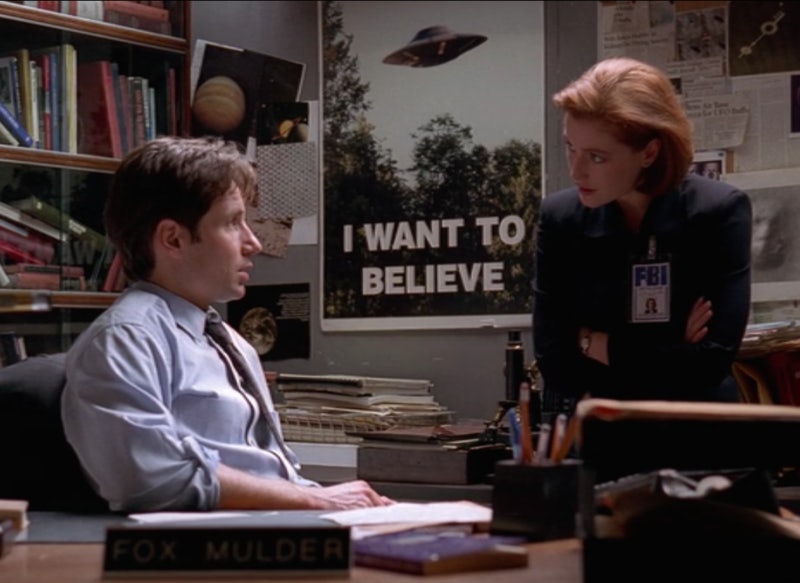
“I Want To Believe.”

This slogan is displayed prominently on a poster above Fox Mulder’s desk in the pilot episode of The X-Files, which went on to become a cultural phenomenon. The show followed two FBI agents as they investigated ETs and the paranormal. It was Agent Mulder who was the open-minded one, counterbalanced by the skeptical Scully, who was always questioning her partner’s “spooky” theories.

It was Agent Mulder, however, who turned out to be correct, as we later learn from a high-level government insider: “they’ve been here for a long, long time.”

Image result for fox mulder i want to believe poster

As a child of the ’90s, it was easy to admire someone like Mulder, enamored by his virtue, bravery, and yes, his willingness to believe. Even through a TV screen, his fervor for the unadulterated truth was contagious indeed, sparking something latent in my young heart and setting it ablaze. Soon, I wanted to believe too.

It wasn’t until my early teenage years, after stumbling across a documentary on the Roswell crash, that I realized there might be something more to this than just belief. There were deathbed confessionals, after all, from top military officials! There were leaked photos of an alleged alien autopsy! Unbelievably, there was even an “alien interview” with a creepy-looking black-eyed being on YouTube!!

“Why aren’t people freaking out over this?!” I wondered. “This is the real X-Files!”

Luckily, once you dig through so much BS you’re bound to find a critical mind. So after researching this topic for over a decade, I recognize that the large majority of stuff on the internet is complete misinformation (perhaps deliberate disinformation), coming to appreciate the skeptical mind of Scully after all.

However, there are several cases that I consider diamonds in the rough, ones we should study thoroughly and take very seriously. These cases lend validity to the idea that we are being visited by creatures from another planet—possibly, even, “for a long, long time.” Hence leads me to the creation of a series I will aptly title “The Real X-Files,” exploring the best evidence I’ve come across for ET life.

In this first installment, we analyze the groundbreaking work of Dr. John Mack, particularly delving into the extraordinary case of the children of Ruwa, Zimbabwe. So open your mind, come along on this journey, and leave everything you thought you knew about reality behind . . .

“The alien abduction experiences themselves are often initially quite frightening. Yet over time many experiencers form a powerful bond with one or more of these beings. People become deeply connected with these entities.

“They have palpable experiences that are just as powerful, sometimes more powerful, than relationships here. They view them not just as these cold, calculating, indifferent big-eyed creatures, but bonds develop between experiencers and those strange creatures which often has an intense, transcendent, spiritual, sometimes even erotic, element to it.

“. . . [They] are coming now ‘because they are conscious that we as human beings on this planet are destroying ourselves, and they love us and wouldn’t see this happening.’ They are trying to influence us by bringing knowledge and understanding of our connection to each other and to the Earth and a reminder that ‘we are just one part of a big, big whole.'”

-Dr. John Mack, speech at Seven Stars Bookstore (2000)

There was a Time When John E. Mack was an Academic Superstar.

He was a force in developmental psychology. In 1977, he was awarded the Pulitzer Prize for his book A Prince of Our Disorder. That same year, he became department head at Harvard Medical School, specializing in child psychiatry, where he was well-respected throughout the entire university. He interviewed US presidents. He was a prominent voice of nuclear disarmament. And in 1985, he was part of an organization that was given the Nobel Peace Prize, teaming up with other intellectuals who shared this same view.

John Mack was a man who could have played it safe. He could have lived a long and comfortable life, emboldened by his wealth and academic stature. All that changed by the turn of the ’90s, when he did something so unspeakable for a man in his position it shattered his reputation among colleagues:

He began taking cases of UFO contactees seriously.

Read more

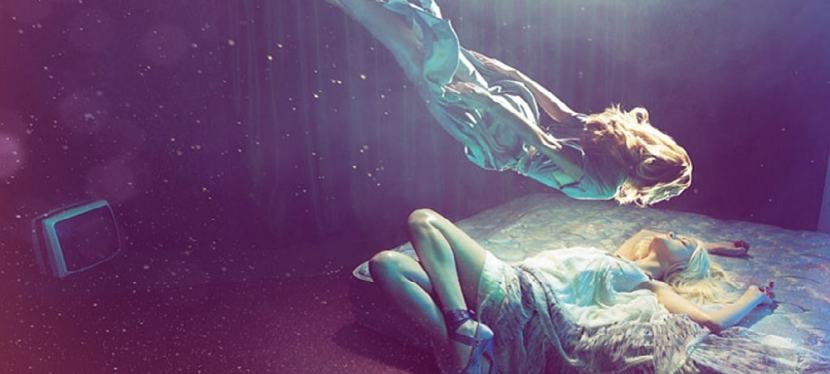
For Life is But a Dream: Exploring Ideas of Lucid Dreaming, Astral Projection, Synchronicity, and the Essential Validity of Non-Physical Reality

“I went to Africa. You can go to Africa. You may have trouble arranging the time or the money, but everybody has trouble arranging something. I believe you can travel anywhere if you want to badly enough.

“And I believe the same is true of inner travel. You don’t have to take my word about chakras or healing energy or auras. You can find about them for yourself if you want to. Don’t take my word for it. Be as skeptical as you like.

“Find out for yourself.”

-Michael Crichton, Travels (1988)

It was the Summer of Inception-Mania:

Ke$ha was in the charts. Oil was in the ocean. Cleveland just lost half its economy. And the characters of Lost finally found themselves. But it was Christopher Nolan’s mind-bending film that captivated the nation, and if only for a short while, granted us a break from reality, thrown through a realm where the laws of physics don’t apply.

With a smart premise and a sexy cast, the movie was a hit, and the main question on everybody’s mind was if that little totem thing was still spinning at the end: Was it all a dream within a dream within a dream?!

Or, going further . . .

Read more

Because They Matter Too: A Question on the Value of Animal Lives

“The question is not, Can they reason?, nor Can they talk? but, Can they suffer? Why should the law refuse its protection to any sensitive being? The time will come when humanity will extend its mantle over everything which breathes.”

-Jeremy Bentham,  Introduction to the Principles of Morals and Legislation (1789)

An innocent gorilla was killed last Saturday. His name was Harambe.

By now you should have heard the news.

The incident was sparked when a 4-year-old boy managed to fall into the “Gorilla World” enclosure at the Cincinnati Zoo, only to have the enormous animal rush over to the child, drag him around like a toy, and proceed to stand guard over him for several minutes. All while onlookers gasped with fright, and parents pleaded for divine intervention.

Ruling out the use of tranquilizers, the zoo opted for the abhorrent—the unthinkable—and shot down the beautiful beast, depriving him of precious spirit, rendering his 450lb frame cold and lifeless. His family will likely grieve uncontrollably. The zoo will forever be marred with darkness. And all because some damn humans couldn’t keep an eye on their child!

This was nothing short of a tragedy.

Read more